
Have a question?
Send us a message and we will reply by email. Or open a free account now: every account starts with 60 days of the Team plan, and no card is needed.
A quote typed up from notes always leaves something off. The scaffold, the longer run to the consumer unit, the second bird protection kit. You either take it out of your own margin or make an awkward call, and neither of those was in the price.
The other half of the same problem is not knowing what the job is making while you are pricing it. A round number feels safe, a discount feels generous, and nobody finds out which of those was true until the accounts are done.

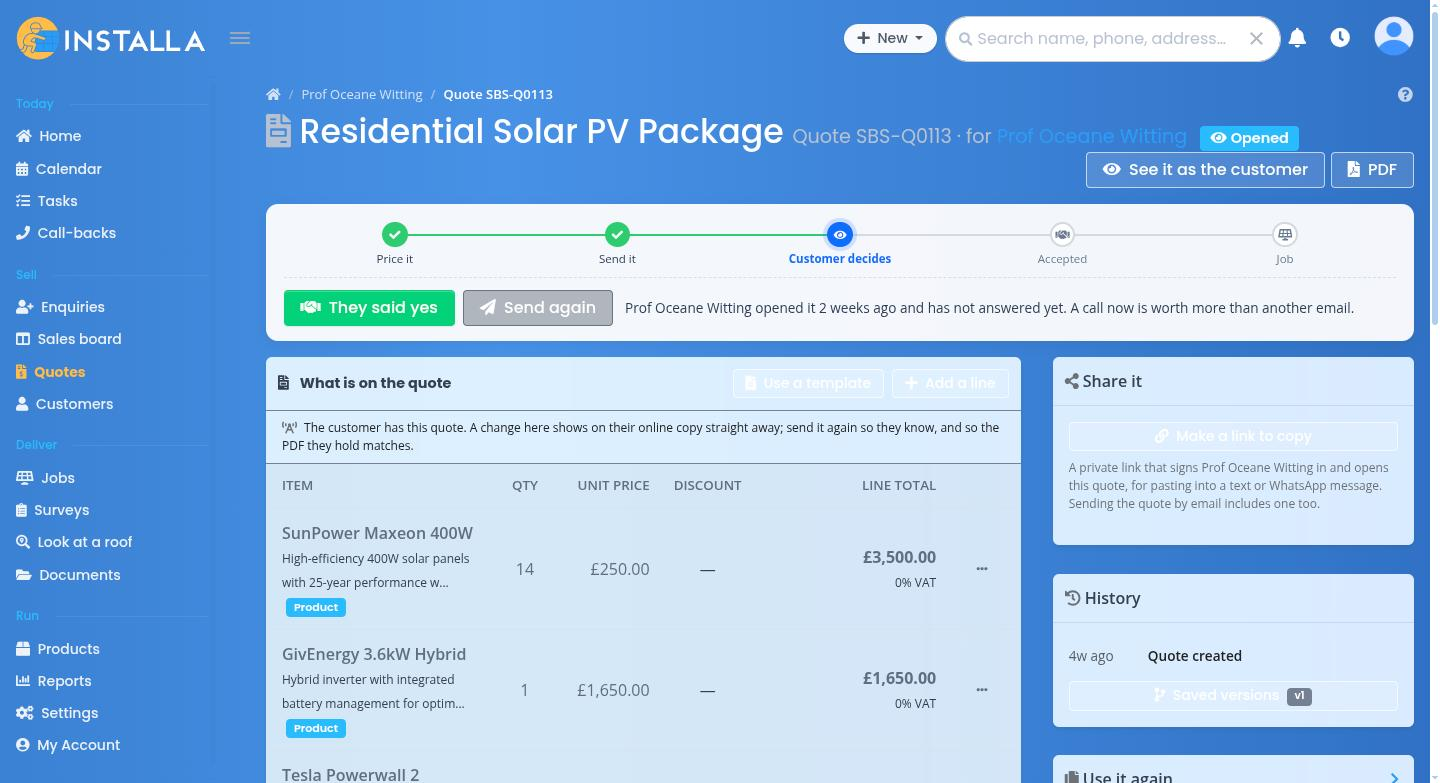
The panels, the inverter, the battery and the cable runs come across as priced lines.

Each line carries its cost, so you know what you are making before you send it.

The customer reads the quote in your branding and accepts it there.

Switch on quote reminders and quotes with no answer are followed up, with a note to the customer before the price expires.
The quote is built from the design in one step. The panels, the inverter, the battery and the cable runs come across as priced lines, so the thing you drew and the thing you charged for are the same thing. Nothing is copied over by hand, which is where things normally get dropped.
Every line carries its cost as well as its price, so the margin is in front of you while you are still deciding what to charge. If you knock something off to win the job, you can see what you have knocked it off.

Most householders ask three companies. The one who gets a proper quote in front of them first is a long way ahead, and the one who takes until next Wednesday is often quoting against a decision that has already been made.
Because the quote comes out of the design, the pricing is the short part. Start from a template, put your own logo and colours on it, preview the email before it goes, and send it as a PDF and an online copy together. If you trade under more than one name, each has its own branding.
The customer gets a private link that opens their quote in your branding. They can read what is included line by line, see what the system should generate in a year, what it should save them and roughly when it pays for itself, with a chart rather than a paragraph of arithmetic.
They can tick optional extras you have offered, ask you a question from the page, and accept or decline it there. The same page stays with them after they say yes, so the job, the photographs and the paperwork are somewhere they can find without ringing you.

Quotes are rarely lost with a no. They go quiet, the week gets busy, and three months later nobody is sure whether that one was ever followed up.

Installa can tell you when the customer opened the online quote. It cannot tell you whether anybody read the PDF attached to the email, and it does not pretend otherwise.
Switch on quote reminders in your company settings and a quote with no answer gets a nudge after a few days and a note before the price expires. Every quote shows where it stands.

You can see what changed and put an earlier one back, and the one they accept becomes the job in a single step, with what was agreed still attached to it.

Better you know before you start than after.
A quote is one step in the job, not a document you make separately.
The seven parts of a quote the customer can check, and what happens when they say yes.
Read the guidePut in one real enquiry, draw the roof, check the design and send yourself the quote. You will know within the hour whether Installa would have caught the things that went wrong last month.
Start free Ask a question